We use cookies for analytics and ads to improve this site. Privacy policy

Cookie settings

Strictly necessary cookies (security, and remembering this choice) are always on. Privacy policy

Analytics & ads cookies

The method

The Self-Running Business System

Six layers that bring in leads, follow up automatically and run operations, so the business grows without depending on you. Systems over hustle.

The six layers

What each layer fixes

Layer 01 of 06

Diagnose

“Pata hi nahi kahan se paisa aur time leak ho raha hai.”

You know the business should earn more for the effort, but you cannot say where the leaks are.

Typical timeline
1–2 weeks
Typical price
₹25k–₹1L +18% GST
See the service: Growth Diagnostic →

What gets installed

  • Process and numbers review
  • Automation Scorecard
  • A ranked 90-day roadmap

Building blocks

  • Scorecard quiz
  • Process mapping
  • Baseline MIS

Signs it's working

  • You can name the biggest leaks in the business, in order
  • Every item on the 90-day roadmap has an owner and a date
  • There is a written baseline for leads, sales and cash to judge every change against

Why the order matters

Fix the layer underneath first

Most businesses buy ads, then a CRM, then a website, in no particular order. Each fix fails because the layer under it is missing.

  1. DiagnoseSee where it leaks
  2. CredibilityLook reliable when checked
  3. DemandSteady, tracked enquiries
  4. ConvertEvery enquiry followed up
  5. OperateWork moves without you
  6. Measure & RunNumbers you can run on

Why most automation fails: It is rarely the software

Most failed automation projects fail for the same few reasons. Each one is a layer installed out of order.

  1. Software before process

    A CRM bought before anyone agrees how a lead should be handled just stores the same mess in a new place.

  2. Automating a broken step

    If quotes go out late because nobody owns them, an automatic reminder only reminds nobody, faster.

  3. Ads before follow-up

    Paying for enquiries that nobody answers the same day is the most expensive way to learn the Convert layer is missing.

  4. Nobody owns the system

    Tools are set up, the person who set them up moves on, and in three months the team is back on WhatsApp groups and registers.

  5. No numbers to judge it

    Without a baseline, nobody can say whether a change worked, so the next idea replaces it before it has a chance.

30-second self-check

Which layer is holding you back?

Tap every line that sounds like your business. Nothing is sent anywhere.

Your starting layer

Tap the lines that fit. The lowest layer you pick is where to start: each layer rests on the one below it.

Illustrative example

One business, six layers

A made-up building-hardware distributor in Jaipur: about ₹12 Cr turnover, 30 staff. The owner approves every quote, chases every payment and is the only one who knows the numbers.

A composite example to show how the layers connect, including the month-by-month spread. It is not a client story and makes no claim about results.

  1. Month 1

    • Diagnose

      A lead-to-cash map shows enquiries scattered across phone, WhatsApp and a marketplace. Follow-up goes first, ads last.

    • Credibility

      The maps listing and website are fixed, and every contractor gets a review request after delivery.

    The owner knows what to fix first.

  2. Month 2

    • Demand

      Search ads reach contractors and builders, and every enquiry is traced to the ad that brought it.

    • Convert

      Every enquiry gets an instant WhatsApp reply, an owner in the CRM, and follow-ups until it closes.

    Every enquiry now has an owner.

  3. Month 3

    • Operate

      Orders, stock and dispatch move into one system, with short SOPs for quoting, dispatch and returns.

    Sales stops phoning the godown to ask.

  4. Month 4 onwards

    • Measure & Run

      One dashboard shows enquiries, quotes won, pending orders and overdue payments. A monthly review assigns actions.

    The numbers come to the owner.

Questions

Questions about the method

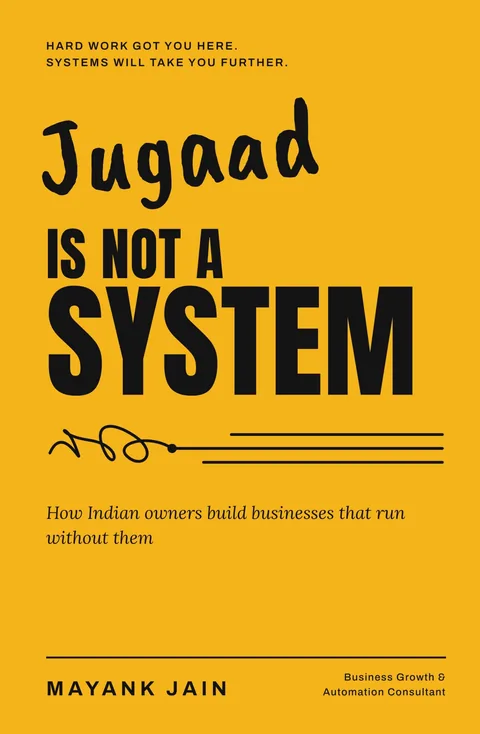
Prices for every step, the full system included, are on the prices page. The thinking behind it is in the book Jugaad Is Not a System.

Each layer has a typical timeline listed on this page, from one to two weeks for the diagnosis to several weeks for a CRM or ERP. Most owners install them over a few months, one or two layers at a time, not all at once.

No. The diagnosis tells you which layer is costing you most. Some businesses already have a good website or a working CRM, and only need the layers above or below it.

Often, yes. The roadmap from the diagnostic is written so your team can act on it. Owners bring us in for the layers that need specialist setup, or to keep the work moving.

No. The same six layers apply to manufacturers, traders and distributors, service firms, retailers and D2C brands. What changes is what gets installed inside each layer.

It depends on which layers you need. Single services are priced on their own pages, and the full system is sold as Growth OS. Start with the free scorecard or a diagnostic to see what you actually need.
Mayank Jain

Where is your business on these six layers?

A Growth Diagnostic scores each one and gives you a 90-day plan. Start with a free strategy call.